
The Ridge Vent Problem Nobody Talks About: Why Your Austin Second Story Is Always Hot

The guy calls me on a Saturday. Says his upstairs is always hot. Like ten degrees hotter than downstairs even with the AC running flat out. He’s done everything. New insulation in the attic. Insulated curtains. Smart thermostat. Ceiling fan on every room. Nothing works.
Built the house in 2018. Nice house. North Austin. Decent-sized two-story.
I went out on a Monday. Climbed up there.
His ridge vent was a scam. Not a malicious one. Just one of those things that happens when a builder is optimizing for speed and a roofer installs what the builder asks for and nobody upstream is asking whether the whole system actually works.
Key Takeaways
A ridge vent only works if it has matching intake ventilation — and most Austin homes don’t, even when the builder says they do.
Hot second-story bedrooms are often a roof ventilation problem, not an insulation or AC problem.
The fix usually isn’t adding more vents. It’s balancing what’s already there.
Bad attic ventilation shortens roof life by 30 to 50 percent in Austin. The shingles bake from below.
How a Ridge Vent Is Supposed to Work
The idea is simple. Hot air rises. You put an opening at the very top of the roof — that’s the ridge vent, a continuous slot running along the peak — and hot air escapes.
Fresh air comes in through the soffit vents along the eaves. Air circulates. Attic stays close to ambient temperature. Roof stays cooler. House stays cooler.
That’s the theory.
What actually happens in a lot of Austin homes is this. Ridge vent is installed. Soffit vents are either missing, blocked by insulation, or too small to feed the ridge. Air doesn’t circulate. Hot air just sits up there with nowhere to go because there’s no intake pulling new air in.
It’s like trying to drink a milkshake through a straw with a hole in the side. You’re pulling but nothing’s moving.
What I Found on That North Austin Roof
Ridge vent looked great from the outside. Clean continuous run across the peak. Good quality product — Owens Corning, nothing wrong with it.
I went into the attic.
Attic was 149 degrees at 2 PM. Hotter than the roof surface. That’s a sign.
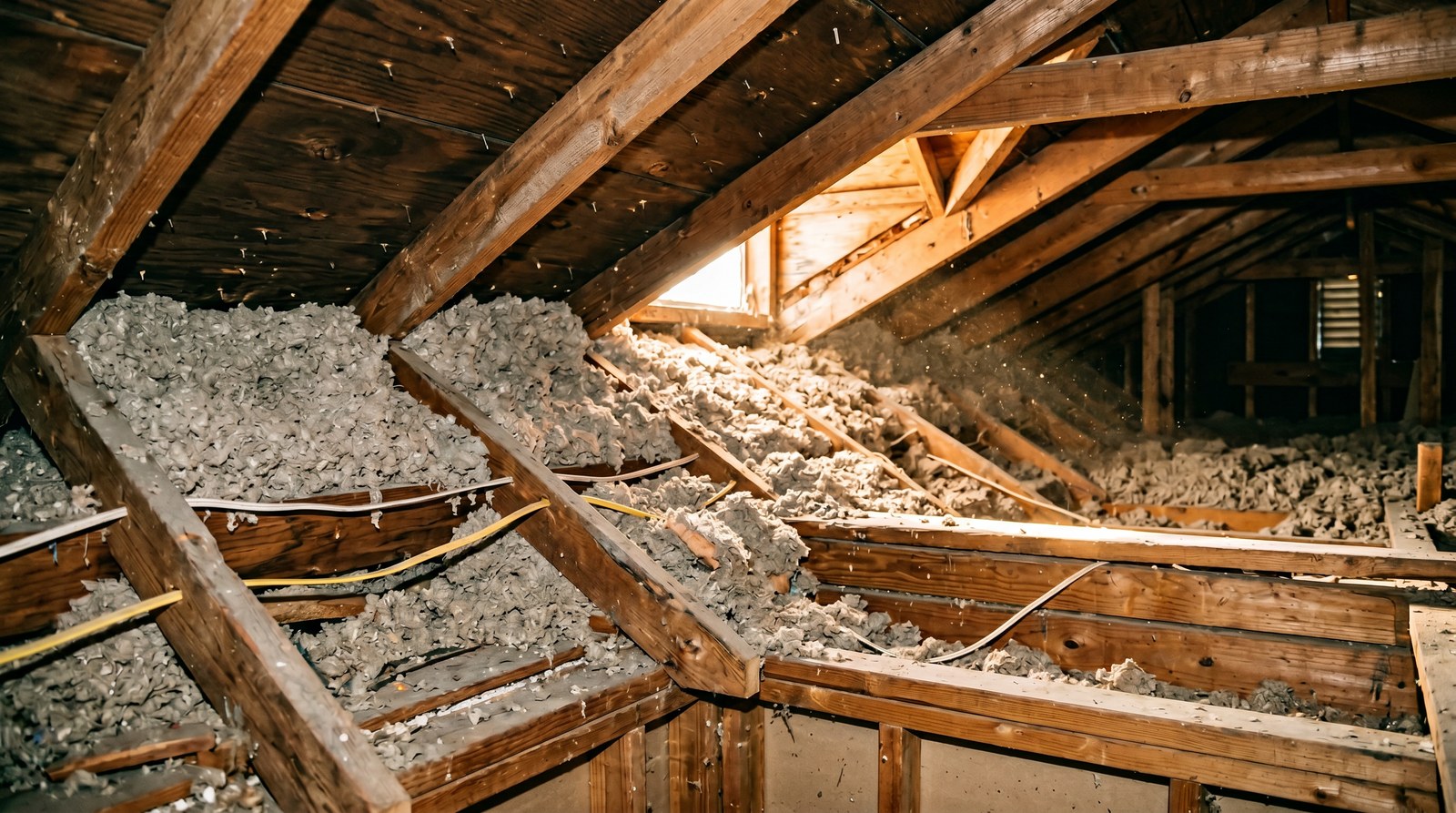
Walked the perimeter. Every single soffit bay was stuffed with blown-in insulation. Someone — probably whoever did the insulation upgrade a few years back — had packed it right up against the roof decking. Completely blocked the intake path.
So the ridge vent had nowhere to pull from. Air just wasn’t moving.
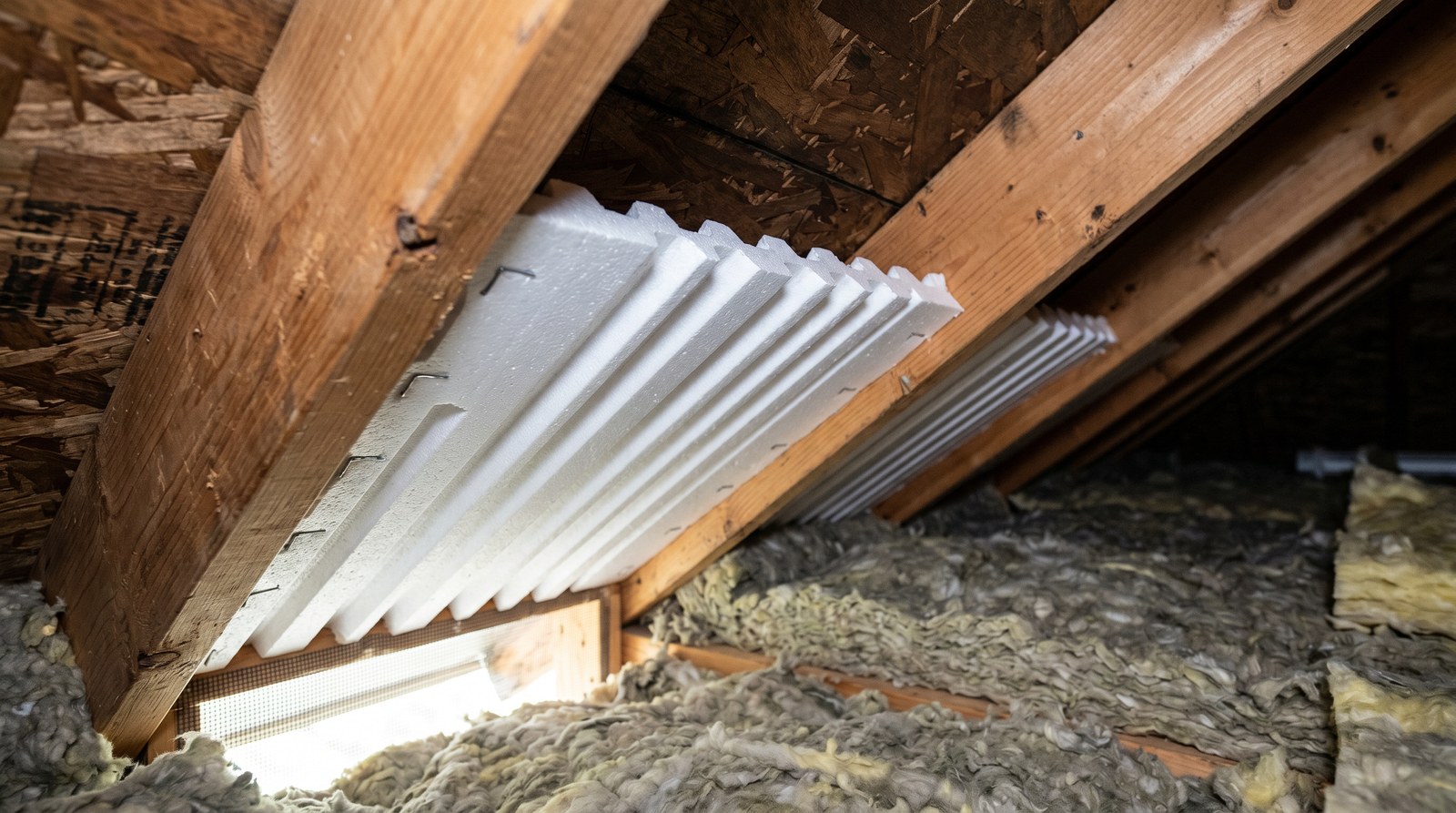
You could fix this for about $400 to $800 depending on the house. Install baffles between the rafters at every soffit location. The baffles are these little cardboard or foam channels that create a clear passage between the soffit and the attic, keeping insulation out of the airflow. Simple. Cheap. Almost nobody checks for this.
We did his in a morning. Temperature difference was noticeable by dinner.
The Ratio That Matters
Code says you need one square foot of net free ventilation area per 150 square feet of attic floor. And that area needs to be split roughly 50/50 between intake (low) and exhaust (high).
On a 2,000 square foot attic, that’s about 13 square feet of total venting. Half down low in the soffits, half up high in the ridge.
Most Austin builds check the box at 1-to-300 instead of 1-to-150, and they lean exhaust-heavy because ridge vents look good on plans. Which means the system is starved on the intake side from day one, before any insulation contractor makes it worse.
This isn’t a code violation in most cases. The minimum code allows it. But minimum code doesn’t cut it in a Texas summer.
Signs You Have This Problem
Upstairs rooms run hotter than downstairs by more than a few degrees with AC running normally. This is the big one.
Your second-floor AC unit runs constantly in summer. The system can’t keep up because heat is being driven down through the ceiling.
You have ice dams in winter — which yes, Austin gets rare winter weather, but when we do, a badly ventilated attic is the first thing to form ice at the eaves.
Shingle edges are curling or buckling on a roof that’s less than 10 years old. That’s from heat from below, not sun from above.
Your attic smells musty or you see dark staining on the underside of the roof decking. Trapped moisture. Ventilation problem almost always.
Your attic temperature is more than 40 degrees hotter than outside on a summer afternoon. Open a thermometer up there and check. Anything over 140 is a problem.
Why Builders Cheap Out on This
Soffit vents cost money. So do baffles. So does taking the time to calculate proper ventilation ratios for each individual roofline.
Ridge vent is a continuous strip you roll out. Fast to install. Looks clean. Inspector signs off because the math on the plans says it’s enough.
Nobody opens the attic two years later and checks whether any air is actually moving.
I’m not blaming individual builders. Most of them are doing what’s on the plans and moving to the next house. This is a systems problem. The incentives reward fast construction that meets minimum code, not optimized construction that works in Austin’s climate for 30 years.
Your roof pays for that shortcut. Your AC bill pays for it. Your upstairs bedroom pays for it every July night you try to sleep up there.
What a Proper Fix Looks Like
First, diagnosis. We come out, get in the attic with a thermometer and a flashlight, and figure out what’s actually happening. Sometimes the fix is simple. Sometimes it’s complicated.
Soffit baffles
If insulation is blocking the intake, we install baffles. One in every rafter bay at the perimeter. Takes a morning. Dramatic improvement in most cases.
Add intake
If the soffit vents are undersized or missing entirely, we add them. That might mean cutting new openings in the soffit and installing vented panels. Or if there’s no soffit at all — which happens on some older Austin homes — we install edge vents or starter vents along the lower edge of the roof.
Check the ridge vent
Sometimes the ridge vent is a problem too. Some cheaper products have baffles inside that block airflow in the wrong wind conditions. We’ve pulled up ridge vents on houses and found they were never properly cut. The roofer rolled the vent over solid decking. Literally no opening underneath. The vent was decorative.
Mechanical help
For tough cases, a solar-powered attic fan can move a lot of air. Not for every house. But for houses with limited ridge space or complex rooflines with dead zones, they work. The solar versions don’t add to your electric bill.
What It Does for Your Roof
Austin shingles are rated for 20 to 30 years. Most of them fail in 12 to 18.
The heat is why. A properly ventilated attic in Austin runs maybe 20 degrees above ambient. A badly ventilated one can run 50 to 60 degrees above. That extra heat cooks the shingles from underneath. Granules shed faster. Asphalt binders break down. Cracks form. The top side looks fine for years while the bottom is slowly destroying itself.
We’ve torn off 14-year-old roofs that looked terrible from above and realized the root cause was never the shingles. It was the attic.
Fixing ventilation adds years to the roof you already have. And it extends the roof you’ll install next.
What the Ventilation Fix Costs
Baffles alone in a standard attic — $400 to $800.
Adding soffit vents with baffles — $800 to $1,800 depending on house.
Complex fix with multiple interventions, possibly including ridge vent replacement — $2,000 to $4,000.
Solar attic fan installed — $600 to $1,200 per fan.
Compare that to your summer cooling costs over the life of the roof. Or the cost of replacing your roof five to seven years earlier than you should’ve. The math is not subtle.
A Last Thing About the North Austin House
He called me back about three weeks after we did the baffles. Said his upstairs was now within two or three degrees of the downstairs. AC wasn’t running as much. He’d actually opened the upstairs windows at night for the first time since moving in.
That was an $650 fix. Not a new roof. Not a new AC. Not more insulation. Just letting air do what it’s supposed to do.
Sometimes that’s what a roofing problem looks like.
Explore More Roofing Services
Free Attic Check
If you’ve got a hot upstairs or rooms that don’t cool right, let us take a look before you call another AC tech. We’ll get in the attic, measure temperatures, check the ventilation setup, and tell you straight whether the problem is up there or somewhere else.
Call RoofsOnly at (512) 746-7090 or book online. HAAG certified. Owens Corning preferred. Honest answers, whether you end up hiring us or not.
