

Metal Roofing in Austin, TX

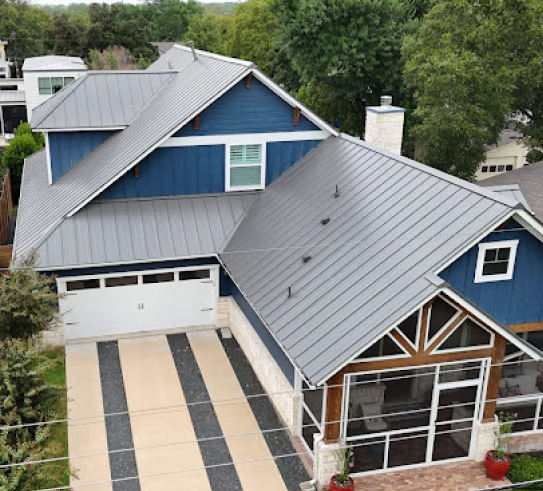
Metal Roofing in Austin, TX — RoofsOnly.com
If you own a home in Central Texas and you haven’t seriously considered a metal roof, it’s worth taking another look. Austin’s climate is one of the hardest on conventional roofing — intense summer heat, sudden hailstorms, heavy UV exposure year-round, and the kind of wind that shreds shingle edges in a single storm. Metal roofing was built for exactly this environment.
At RoofsOnly.com, metal roofing is one of our most-requested services. We install standing seam metal roofs, stone-coated steel, and metal shingles across Austin and the surrounding communities. Whether you’re replacing a failing asphalt roof, dealing with repeated hail damage, or building new and want a roof that won’t need replacing in 15 years — this page covers everything you need to know about metal roofing in Central Texas.
We do one thing: roofing. That focus means every conversation we have about metal roofing is coming from real installation experience in this market — not a sales pitch from a company that does gutters and siding on the side.
A Note From Our Owner
“Metal roofing used to be something we’d recommend to a specific type of homeowner — someone building in the Hill Country, or someone who’d already replaced their asphalt roof twice and was done with it. Now we’re having that conversation with almost everyone. The hail in this area has gotten more frequent, insurance has gotten more expensive, and homeowners are tired of the cycle. Metal just makes more sense here than it used to, and the products available today look nothing like what people picture when they think of a metal roof.”
— Jake Mullin, Owner, RoofsOnly.com
Types of Metal Roofing We Install
Not all metal roofing is the same. There are three distinct systems we work with at RoofsOnly.com, each with its own performance profile, aesthetic, and ideal use case. Understanding the difference is the first step to choosing the right one for your home.
- Standing Seam Metal Roofing — The premium option. Continuous vertical panels with concealed fasteners, designed for maximum longevity, watertight performance, and a clean modern look. The system we most often recommend for high-end residential and Hill Country properties.
- Stone-Coated Steel Roofing — Metal performance with a traditional appearance. Steel panels coated with stone granules that mimic the look of asphalt shingles, tile, or shake. The right call when HOA guidelines require a traditional look or when a complex roofline makes standing seam impractical.
- Metal Shingles — Individual interlocking panels that replicate the look of asphalt shingles while delivering meaningful durability improvements. A solid middle-ground option for homeowners moving away from asphalt who aren’t ready for a full premium system.
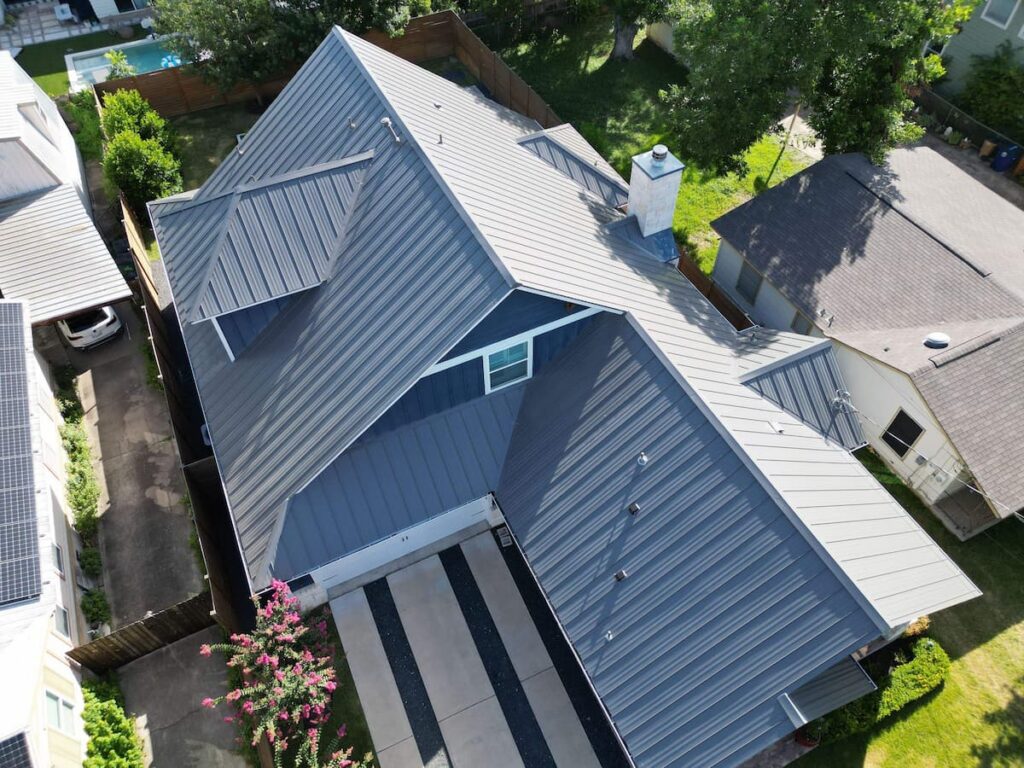
Standing Seam Metal Roofing — The Premium Option
Standing seam is the metal roofing system we install most often on high-end residential properties across Austin and the Hill Country. Panels run continuously from ridge to eave, locking together with raised seams that keep all fasteners concealed beneath the surface. That concealed fastener design is what separates standing seam from cheaper exposed-fastener metal options — and it’s a significant difference in long-term performance.
Exposed fasteners are a known failure point. Over years of thermal expansion and contraction in Austin’s climate, those fastener holes work loose and eventually allow water intrusion. Standing seam eliminates that failure mode entirely. There are no exposed penetrations in the field of the roof — just interlocking panels that move as a unified system.
Why Standing Seam Performs in Central Texas
- Concealed fasteners eliminate the leak points that exposed-fastener panels develop over time in Austin’s heat cycling conditions.
- Wind rated to 140 mph — relevant during Texas thunderstorm season when straight-line winds routinely cause roof damage across the metro.
- Kynar 500® PVDF finish resists UV degradation, chalking, and color fade in the intense Central Texas sun — more on this below.
- Lifespan of 40–70 years compared to 15–20 years for standard asphalt in this climate.
- Reflective finish reduces attic heat load and lowers cooling costs during Austin’s long summer season.
- HOA-friendly profiles available in both modern and traditional color palettes to meet neighborhood guidelines.
Standing seam panels are fabricated from high-grade steel or aluminum and can be roll-formed on-site to match your exact roof dimensions. We walk you through panel profiles, thickness, and color selection as part of our free consultation before any commitment is made.
Stone-Coated Steel — Metal Performance, Traditional Look
Stone-coated steel gives you the structural performance of metal roofing with the appearance of traditional shingles, tile, or shake. A formed steel panel is coated with stone granules bonded with an acrylic film — the result is a surface that’s visually indistinguishable from conventional roofing materials at street level, but performs like metal under the surface.
This is the system we recommend when standing seam isn’t the right fit for a particular project.
Stone-Coated Steel Is the Right Call When:
- Your HOA requires a traditional shingle or tile appearance and standing seam doesn’t meet those guidelines.
- You want metal-grade hail resistance and longevity without the modern standing seam aesthetic.
- Your home has a complex roofline with multiple valleys, hips, and dormers where standing seam installation becomes more complicated.
- You’re looking to maximize insurance savings — most stone-coated steel products carry Class 4 impact ratings, qualifying for premium discounts with many Texas carriers.
Stone-coated steel typically lasts 40–50 years and carries some of the most comprehensive manufacturer warranties available. Brands like DECRA and Gerard have long track records in hail-prone markets like Austin. We have a dedicated page covering stone-coated steel in detail if you want to go deeper on that option.
Metal Shingles — A Solid Step Up From Asphalt
Metal shingles are individual interlocking panels engineered to mimic the look of asphalt shingles while delivering meaningful improvements in durability and lifespan. They’re lighter than stone-coated steel, easier to handle on roofs with complex geometry, and represent a more accessible entry point into metal roofing for homeowners working with tighter budgets.
Metal shingles won’t carry the same warranty profile as standing seam, and they use exposed fasteners — so they don’t eliminate all the long-term maintenance concerns that standing seam does. But they’re a genuine upgrade over asphalt in heat resistance, impact performance, and expected lifespan. For the right homeowner in the right situation, they’re worth considering as part of a full evaluation.

Why Central Texas Is Hard on Conventional Roofing
This isn’t an abstract concern. Austin and the surrounding corridor — Georgetown, Round Rock, Kyle, Lakeway, Buda, Cedar Park — sit in one of the most active hail zones in the United States. Williamson County alone sees multiple significant hail events per year. Combine that with summer temperatures that regularly push roof surface temps past 150°F and UV levels that fade and brittlize shingle granules faster than in almost any other region in the country, and you have a market where asphalt roofing is genuinely underperforming relative to what homeowners expect from it.
Here’s what we see consistently on inspection calls across the Austin metro:
- Granule loss across the entire field on 15–18 year old shingle roofs — often before homeowners even know there’s a problem.
- Thermal cracking on south and west-facing slopes from repeated heat cycling between Austin’s summer highs and winter cold snaps.
- Hail damage that’s invisible from the ground but clearly present on inspection — compromising the waterproofing membrane without any visible surface damage.
- Flashing failures at penetrations from years of expansion and contraction working fasteners and sealants loose over time.
Metal roofing addresses each of these failure modes directly. The material doesn’t granulate, doesn’t crack from heat cycling, is rated to specific hail impact classes, and expands and contracts as a unified system rather than at individual points. It was engineered for the conditions we deal with here — which is why we recommend it as often as we do.
The Kynar 500® Finish — Why It Matters in Austin
The finish on a standing seam metal roof isn’t a cosmetic detail — it’s engineering. Kynar 500® is a PVDF (polyvinylidene fluoride) coating used on some of the most demanding architectural applications in the world. It was developed specifically to handle prolonged UV exposure and significant temperature swings — two things Austin delivers in abundance.
In practical terms for an Austin homeowner, Kynar 500® means:
- Color stays true for decades — no streaking, dulling, or patchy fade from UV exposure the way cheaper coatings experience.
- Resistance to chalking — the powdery surface breakdown that makes lower-grade metal roofs look aged within 10 years in this climate.
- Reflective variants reduce roof surface temperatures, cutting heat load on your HVAC and lowering cooling costs through Austin’s long summer season.
- Fully backed by manufacturer warranty — Kynar 500® panels carry some of the most comprehensive finish warranties available in residential roofing.
Competitor panels without Kynar 500® use inferior paint systems that chalk and fade significantly faster in Central Texas conditions. When we spec a standing seam project, Kynar 500® is not optional.
Energy Efficiency and Insurance Benefits
Metal roofing in Texas comes with two financial upside factors that consistently surprise homeowners when they run the numbers.
Energy Costs
Reflective metal roofing keeps attic temperatures meaningfully lower during Austin summers by reflecting solar radiation rather than absorbing it. Lower attic temperatures mean your HVAC runs less, and cooling costs drop as a result. Estimates vary depending on insulation quality, attic depth, and home orientation — but energy savings in the range of 20–40% on cooling costs are commonly cited for reflective metal roofing in hot climates. In Austin, where summer cooling bills can be substantial, that’s a real number worth factoring into your total cost of ownership calculation.
Insurance Premiums
Many Texas insurance carriers offer reduced premiums for homes with metal roofs due to their superior impact resistance and fire ratings. The discount varies by provider and policy, but it’s a direct conversation worth having with your agent before you finalize any material decision. We document the impact resistance rating of every system we install so you have that information to provide to your insurer. And if you’re dealing with an existing storm or hail claim, we can walk you through our insurance claim process from start to finish.
Our Metal Roofing Installation Process
We don’t sell jobs and hand them off. Every metal roof we install is managed by our own team from the initial evaluation through the final walkthrough. Here’s what the process looks like from your side.
- Step 1 — Free Roof Inspection: We evaluate your current roof, document any existing damage with photos, assess the deck condition, and identify any structural issues before we ever put a number in front of you.
- Step 2 — Detailed Consultation: We walk you through your material options, panel profiles, color selection, and provide a fully transparent quote — no pressure, no upselling.
- Step 3 — Professional Installation: Our certified installers handle every aspect of the project. Most residential installs complete in 3–7 days. We coordinate tear-off, deck inspection, underlayment, and panel installation as one continuous workflow.
- Step 4 — Final Walkthrough and Warranty: We walk the completed roof with you, confirm everything meets our standards, and hand over your warranty documentation before we leave.
We almost always recommend a full tear-off rather than installing over existing shingles. Removing the old material allows us to inspect and repair the deck — problems that would be hidden and would shorten the life of your new roof if left unaddressed. A full tear-off is best practice for maximizing the performance and longevity of your investment.
Frequently Asked Questions About Metal Roofing in Austin
How much does metal roofing cost compared to asphalt shingles?
Metal roofing carries a higher upfront cost than asphalt. The gap varies by system — standing seam is the most expensive option, metal shingles are the most accessible. However, when you factor in lifespan (40–70 years vs. 15–20 for asphalt in this climate), reduced repair frequency, potential energy savings, and potential insurance premium reductions, metal roofing frequently delivers a lower total cost over time. We provide transparent quotes after inspection so you can evaluate the real numbers for your specific situation.
Is a metal roof loud when it rains?
This is the most common concern we hear, and it’s largely a myth with modern installations. When installed correctly over a solid deck with proper underlayment — which is always how we install — a metal roof is not noticeably louder than a shingle roof during rain. Most homeowners tell us afterward that the sound is more muted than they expected.
How long does a metal roof last in Austin?
A properly installed standing seam metal roof will last 40–70 years. Stone-coated steel and metal shingles typically last 40–50 years. Compare that to a standard asphalt roof in Central Texas, which commonly requires replacement in 15–18 years due to UV degradation and hail exposure. Over a 40-year window, a homeowner with asphalt may replace their roof two to three times while a metal roof owner replaces theirs zero times.
Does metal roofing need special ventilation?
Yes — metal roofing has the same ventilation requirements as other roofing systems. Proper ridge and soffit ventilation maintains lower attic temperatures, prevents condensation from building up on the underside of the decking, and is critical to the long-term performance of the full roof assembly. We assess ventilation as part of every installation — it’s not an afterthought.
Can metal roofing be installed over my existing shingles?
Technically possible in some cases, but we almost always recommend a full tear-off. Removing the existing shingles allows us to inspect the deck for rot, water damage, or structural issues — problems that would be hidden under your new roof and would shorten its life if left unaddressed. A full tear-off is best practice for getting the full performance and longevity out of your metal roofing investment.
Does a metal roof increase home value?
Yes. Metal roofing is consistently recognized as a premium upgrade by appraisers and buyers. In Austin’s competitive real estate market, a 50-year roof is a meaningful differentiator — buyers and their agents know the difference between a home that needs a new roof in five years and one that won’t need attention for decades.
Schedule Your Free Metal Roofing Estimate in Austin
If you’re thinking about metal roofing for your home, the best next step is a free in-person inspection. We’ll evaluate your current roof, walk through all three metal roofing options with you, and give you a clear recommendation based on your home, your goals, and your budget — with no pressure to move forward on the spot.
Call us at (512) 746-7090 or reach out through our contact form to get on the schedule. We serve homeowners across Austin, Cedar Park, Round Rock, Leander, Georgetown, Pflugerville, and surrounding communities throughout the greater Austin metro.
Also see: Compare all roofing materials →
Contact Us for Expert Metal Roofing in Austin
RoofsOnly.com installs metal roofing across Austin and the surrounding communities. We know what holds up here and what doesn’t — and we’ll give you a straight answer about whether metal is the right call for your home. Call (512) 746-7090 or visit our main office at 1005 Meredith Drive, Suite B, Austin, TX 78748.
GET A FREE ESTIMATESchedule Your FREE Roof Inspection