
Step-by-Step: How to Read Your Roof Insurance Estimate

Your insurance company sent an estimate full of codes, abbreviations, and line items with no explanation attached. Here’s how to read it, and what to check before you accept the number.
Most Austin homeowners see a roof insurance estimate exactly once, after a storm, under stress, with a decision to make. The document is not written for you. It’s written for adjusters and contractors who already speak the shorthand. Once you know what each section means, the numbers stop being confusing and start being something you can check.

ACV vs. RCV, the Distinction That Matters Most
Two terms drive most of the confusion on a roof estimate:
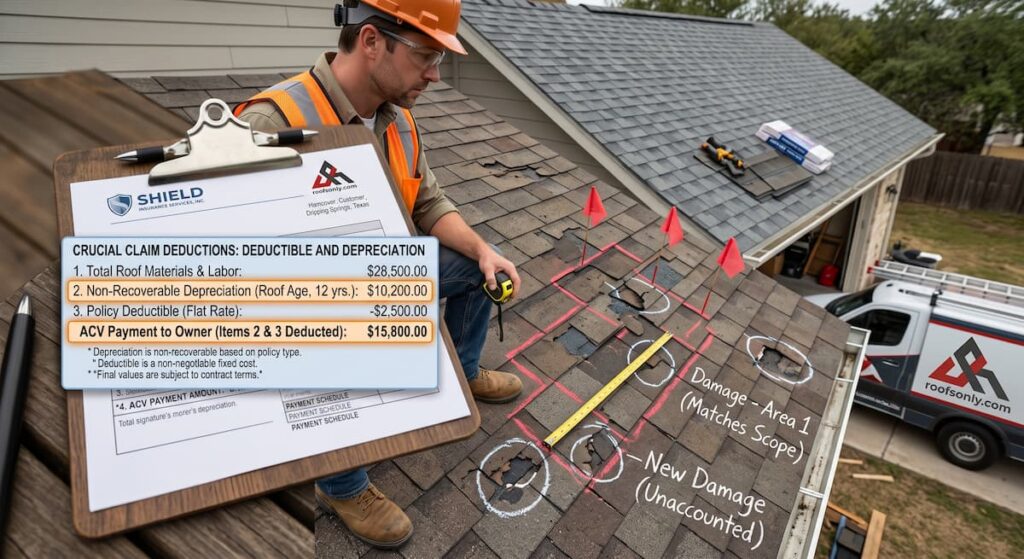
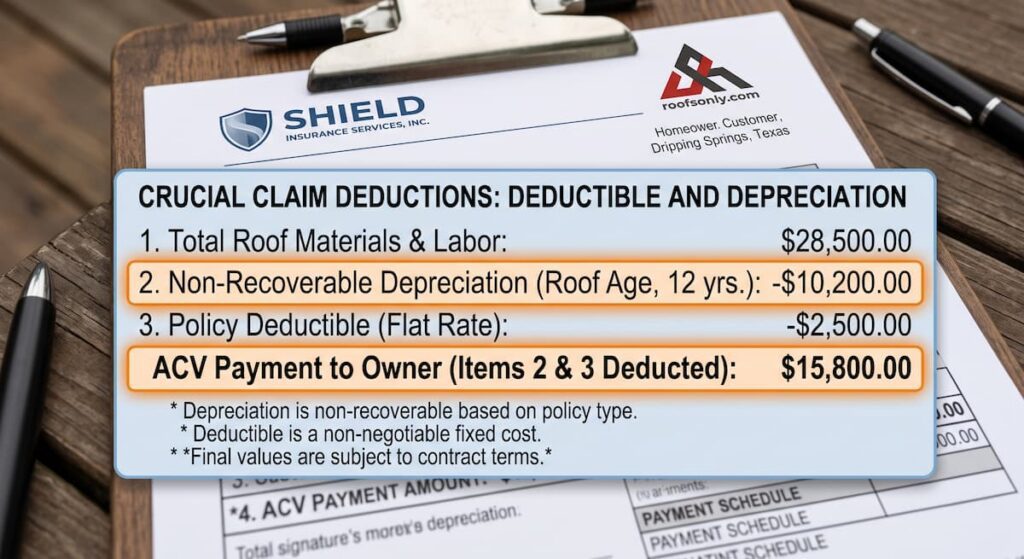
- ACV, Actual Cash Value. The cost to replace your roof minus depreciation for its age and wear. An older roof gets a bigger deduction, even if the storm damage itself is severe.
- RCV, Replacement Cost Value. The full cost to replace your roof with new materials, no depreciation subtracted.
Most policies pay ACV first, then release the depreciation amount, called recoverable depreciation, once you complete the repair and submit proof. If your policy doesn’t include recoverable depreciation, the ACV check is the full amount you’ll get. Check which type of policy you have before you assume the first check is the last one.
Reading the Line Items
Recoverable depreciation vs. non-recoverable depreciation. Recoverable depreciation gets paid back after the work is done. Non-recoverable depreciation does not, it’s a permanent deduction. Your estimate should label which is which. If it doesn’t, ask.
Your deductible. Subtracted from the total before you receive payment. A $5,000 estimate with a $2,000 deductible means a $3,000 check, not $5,000. Confirm the deductible on the estimate matches the deductible on your actual policy, not a generic number.
Overhead and profit (O&P). A percentage, usually 10 to 20 percent combined, added to cover a contractor’s overhead and profit margin. Some policies only include O&P if the job requires coordinating three or more trades. If your estimate has zero O&P listed and your roof needs gutter, decking, and shingle work together, that’s worth questioning.
Scope of work. The specific list of materials and labor the estimate is pricing. Compare this against what a roofing contractor’s own inspection finds. A scope that’s missing decking replacement, ice and water shield, or drip edge, when your roof actually needs those, means the estimate is priced too low before you even look at the total.
What to Check Before You Accept the Number
Run through this before signing off on any insurance estimate:
- Does the scope of work match what a roofing contractor’s own inspection found
- Is recoverable depreciation clearly labeled, and do you know how to claim it after the work is done
- Does the deductible on the estimate match your actual policy
- Is O&P included if the job needs multiple trades coordinated
- Are the materials priced at current local rates, not a generic regional average
“Most homeowners assume the first number they see is the final number. It’s usually a starting point. The estimates we see undervalue decking replacement more than anything else, since that damage doesn’t show until the old roof comes off. That gap is where a second opinion pays for itself.”
— Jake Mullin, Owner, RoofsOnly.com
Not Sure Your Estimate Adds Up?
Email us your scope of loss and we’ll walk through it against what your roof actually needs, no cost, no obligation. If the numbers hold up, you’ll know. If they don’t, you’ll know that too, before you sign anything.
Email Your Scope of Loss for a Free Expert Review
Send Your Estimate